
Creative Home Office Ideas for Small Spaces
Discover six innovative home office ideas perfect for small spaces. From closet conversions to under-stair nooks, this guide offers design tips and curated product picks for renters and homeowners alike, ensuring your workspace is both functional and stylish.
HOME OFFICE
6/14/202610 min read
This post contains affiliate links. If you make a purchase through these links, we may earn a small commission at no extra cost to you.
1. The Cloffice: Turning a Closet Into a Compact Command Center
The cloffice — the portmanteau of closet and office — has become one of the most beloved small-space solutions of the past decade, and for good reason. A standard reach-in closet offers a self-contained footprint and the single greatest gift a home office can offer: the ability to close the doors and make the whole thing disappear at the end of the day. A typical reach-in runs 24 inches deep and 36 to 60 inches wide — more than enough for a monitor, keyboard, and the essentials.
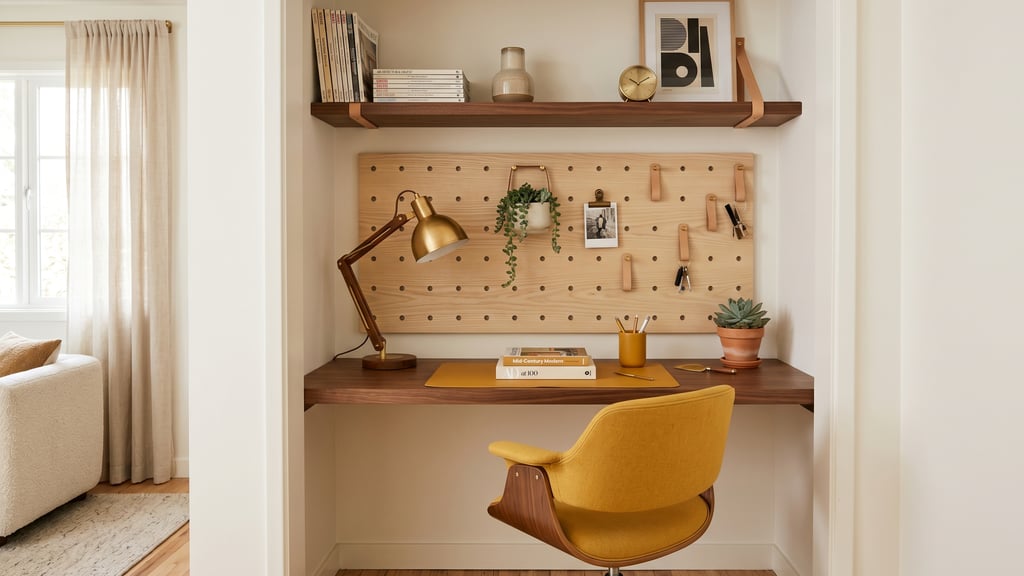
The desk surface itself should be a floating shelf mounted at sitting height, around 29 to 30 inches from the floor. It keeps the floor clear, eliminates visual bulk, and looks intentional rather than improvised. Add open shelving above for books and a few decorative objects, plus a small pegboard for supplies, and you've maximized every inch of vertical space. Lighting is the critical detail most people miss: closet overhead lighting is almost always terrible, so mount an LED puck light or clip-on task lamp under the upper shelf so warm, directional light falls on your work surface.
Style this space like a design moment, not a makeshift fix. In a mid-century scheme, warm walnut floating shelves, brass hardware, and a mustard yellow lamp turn the nook into something genuinely editorial. For a boho feel, layer in a woven rattan organizer, trailing pothos, and a hand-thrown ceramic pot for pens. Contemporary? Paint the back wall a deep jewel tone — emerald, navy, or plum — and let the contrast do the work.
Affiliate picks:
Floating Wall-Mounted Desk— Slim, clean surface.
Floating Shelves With Invisible Brackets— Various sizes to configure your closet dimensions.
Brass Desk Lamp, Adjustable — Essential task lighting for low-ceiling spaces.
Pegboard Wall Organizer Kit with Accessories — Keeps supplies off the desk and visually organized.
🛠️ Tools:
Stud Finder and Wall Scanner — For safely mounting floating shelves.
Cordless Drill and Driver Set — For brackets, pegboard hardware, and shelf installation.
2. The Bedroom Corner Office: Intentional Zone-Making
The bedroom is the most common space people try to fit a home office into — and the most commonly done wrong. Pushing a desk against a wall and dropping a chair in front of it produces a space that never quite feels professional and a bedroom that never quite feels restful. The difference is zone-making: treating the desk area as its own designed environment within the larger room.
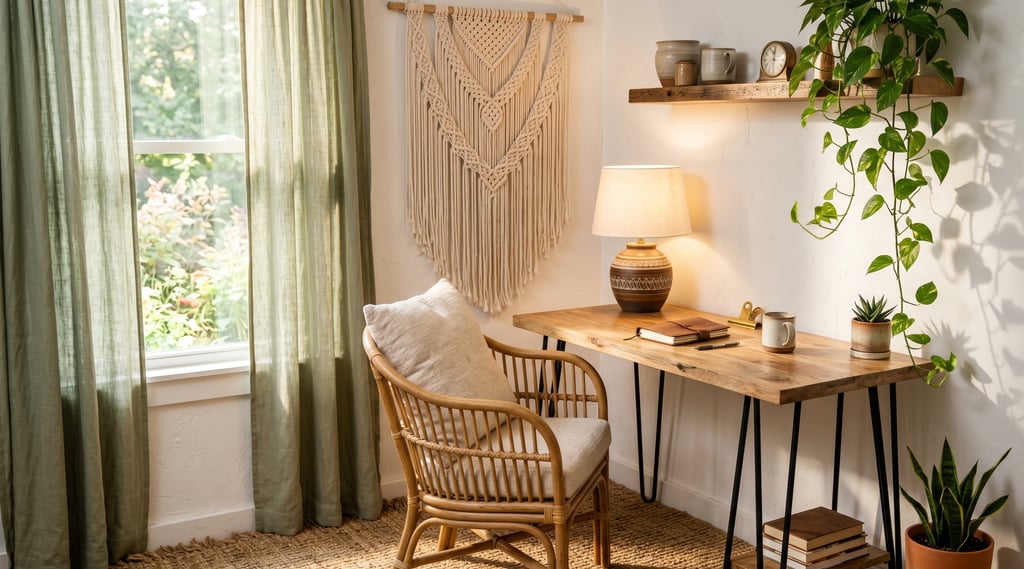
Placement matters first. Facing the wall while you work creates a natural psychological division between work mode and rest mode. A corner setup is even better — two walls give you more surface area and a sense of enclosure that supports focus. Near a window is ideal for natural light and the short visual breaks that reduce eye strain. Once you've found the right spot, define it clearly: an area rug placed beneath and around the desk zone visually anchors the workspace and separates it from the bed, even without a physical divider.
The design direction you choose transforms a desk from office furniture into a room feature. A walnut tapered-leg writing desk with a cognac leather chair is pure mid-century and looks like it belongs. A raw wood desk with a woven wall hanging, trailing pothos, and an earth-tone ceramic lamp is instant boho. A lacquered desk against a deep terracotta or navy accent wall is contemporary with real impact. In every case, the goal is the same: make the workspace look as considered as everything else in the room.
Affiliate picks:
Mid-Century Modern Writing Desk with Tapered Legs — Compact footprint, elevated walnut finish.
Rattan and Wood Desk Chair, Boho Style — Texture and warmth without visual bulk.
Abstract Geometric Area Rug, 4x6 or 5x7 — Zone-defining anchor for a bedroom corner setup.
Woven Wall Hanging, Macramé or Fiber Art — Transforms the wall behind the desk into a styled feature.
3. The Living Room Desk Zone: Integrated and Invisible
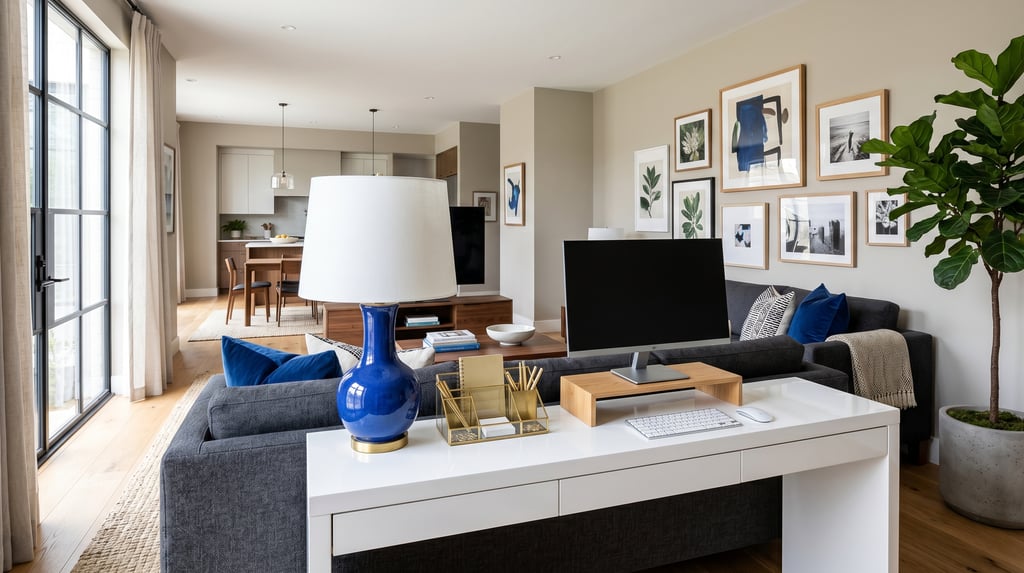
A desk in a living room only works if it looks like it belongs there. The key is integration: choosing furniture-quality pieces and treating the desk as a designed element of the room, not a utilitarian intrusion. The most successful approaches use one of two placement strategies — the sofa-back placement, where a narrow console desk positioned directly behind the sofa creates a back-to-back work zone with the sofa acting as a natural divider, or the alcove approach, where any recessed wall, flanking chimney breast, or deep windowsill becomes a fitted desk and shelving moment.
Cord management is non-negotiable in a living room workspace, where cables are immediately visible to guests. A cable management box, adhesive clips along the baseboard, and wireless peripherals — keyboard, mouse, headset — dramatically reduce visual noise. Storage should pull double duty: decorative baskets, lidded boxes, and hardback books used as monitor risers all serve both organizational and aesthetic functions. A small two-drawer filing cabinet in a matte finish that matches the room's palette can slide under the desk and never announce itself as office furniture.
Style continuity is the final piece. In a contemporary scheme, a sleek white or lacquered console desk against a bold cobalt or emerald wall reads as a feature, not a compromise. For mid-century, a walnut-and-brass desk lamp and a streamlined low-profile desk integrate seamlessly with a curated living room. Boho living rooms love a natural wood desk with a gathered linen curtain that can be pulled across the workspace at the end of the day — hiding everything behind a textural, beautiful panel.
Affiliate picks:
Narrow Console Desk / Sofa Table, 43-inch — Slim profile elegant enough for living room placement.
Wireless Keyboard and Mouse Combo, white — Eliminates desk cable clutter instantly.
Cable Management Box with Cord Organizer — Hides power strips in a decorative enclosure.
Decorative Storage Baskets with Lids, Set of 3 — Stylish supply storage that doubles as living room
décor.
🛠️ Tools:
Adhesive Cable Clips and Cord Organizer Strips — Routes cables along baseboards cleanly and invisibly.
Introduction: You Don't Need a Spare Room
The idea that you need an entire room to work productively from home is one of the most persistent myths in interior design. The reality? Some of the most beautifully functional home offices in the world occupy nothing more than a closet, a landing at the top of the stairs, or a bedroom corner that most people walk right past without a second glance.
What a no-spare-room workspace is really about is intentionality. When you can't fall back on a dedicated room, you're forced to think carefully about what you actually need: the right surface height, decent light, adequate storage, and a psychological sense of separation from the rest of your home life. It turns out those four things can fit almost anywhere — and when they're styled well, the result is often more interesting than a generic home office would ever be.
The sections below cover six proven approaches, with Amazon product picks, styling notes across three design directions (mid-century modern, boho, and contemporary with a color pop), and 8K image prompts for every section.
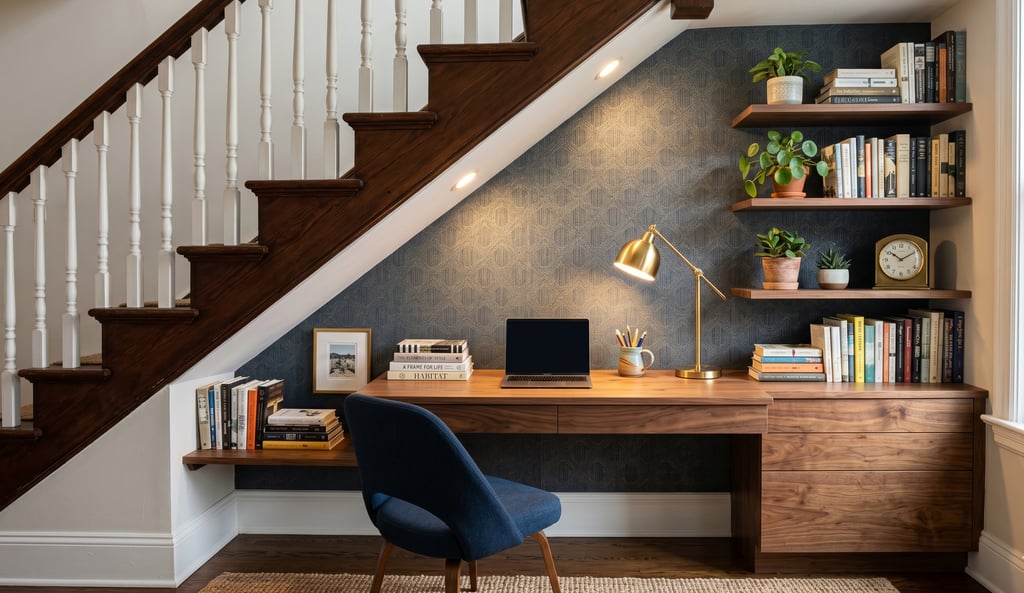
4. The Under-Stair Office: Architecture as Opportunity
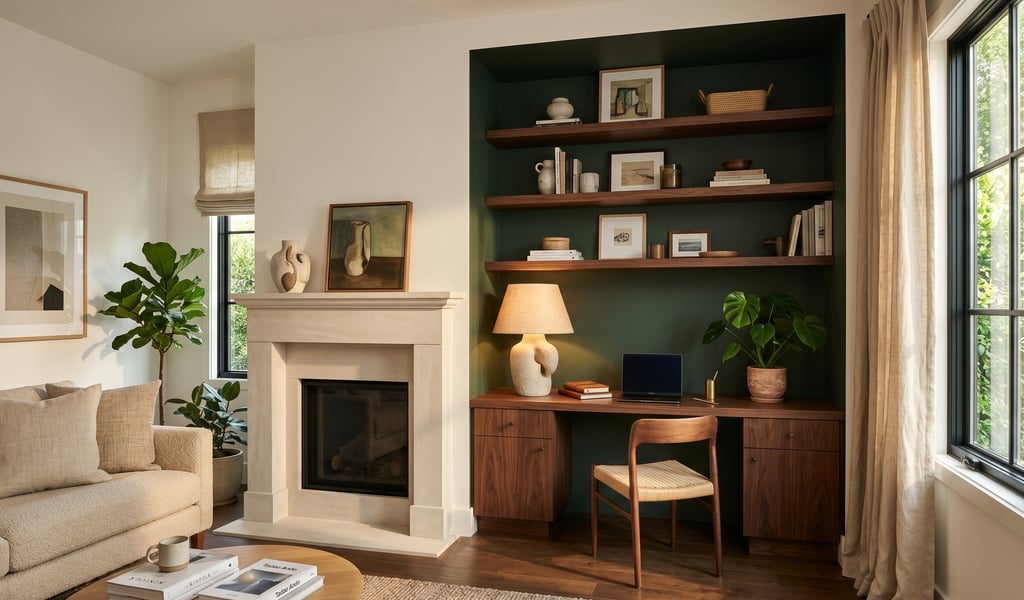
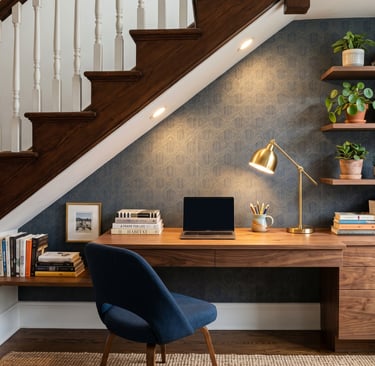
The space beneath a staircase is one of the most underutilized architectural features in a typical home — usually treated as dead storage for the vacuum and holiday boxes when it's actually one of the most charming office footprints available. The triangular geometry forces creativity, and the result, when done intentionally, looks like it was always meant to be there.
The most functional under-stair setups use a desk surface that follows the diagonal line of the stair treads above — deeper at one end, narrowing toward a point. If custom millwork isn't in the budget, a standard desk positioned at the wide end plus floating shelves on the side walls achieves a similar effect. Built-in lighting is essential since the staircase blocks overhead light; LED puck lights mounted on the underside of the treads above or warm LED strip lighting under shelves create an even, cozy wash that feels finished rather than improvised.
Design personality is where an under-stair nook goes from tucked-away to showstopping. Paint the back wall a deep jewel tone — emerald, sapphire, or terracotta — to create depth and frame the workspace like a stage. Lean framed prints against the wall rather than hanging them, mix a brass gooseneck lamp with a hand-thrown ceramic organizer, and add a gathered linen curtain on a tension rod across the opening so the whole thing can disappear completely when you close it off. Renter-friendly and genuinely beautiful.
Affiliate picks:
LED Puck Lights, Wireless with Remote, Warm White — Mountable on stair tread undersides for flush desk lighting.
LED Strip Lights for Under-Shelf, Warm White, Dimmable — Runs along shelf undersides for ambient task light.
Brass Gooseneck Desk Lamp, Adjustable — Sculptural, classic lamp with genuine design presence.
Linen Curtain Panel, Natural or Cream — Renter-friendly way to conceal the entire workspace off-hours.
🛠️ Tools:
Digital Level and Measuring Tape, Combo Set — Essential for working with angled under-stair geometry.
6. Quick Wins: Ergonomics That Make Any Setup Feel Professional
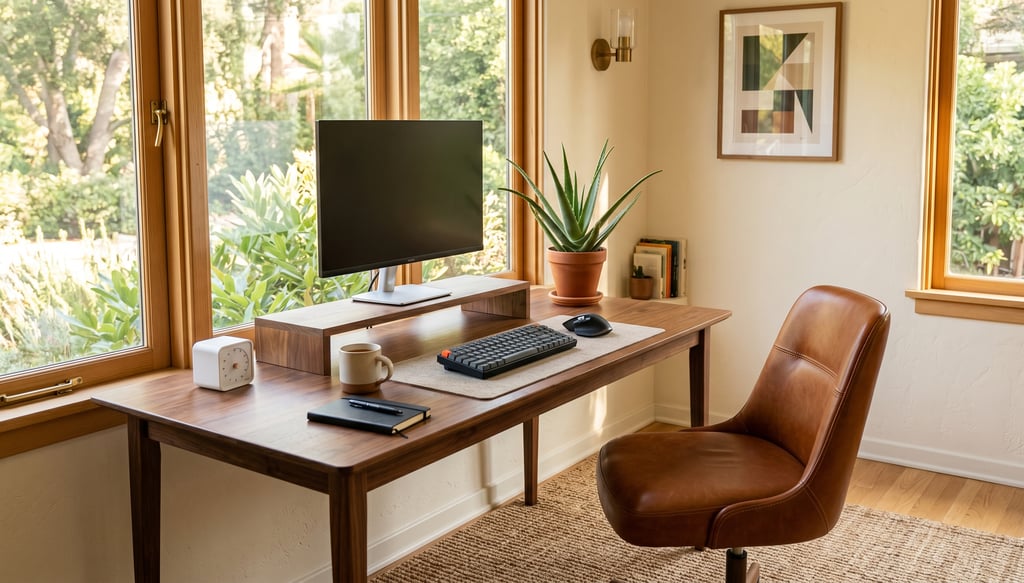
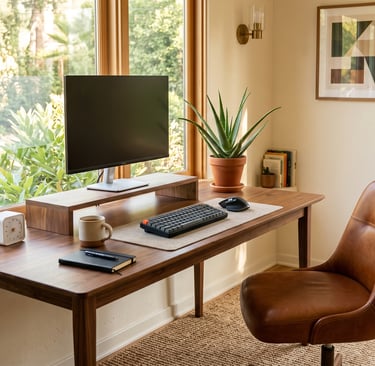
No matter which space you've chosen, the physical setup determines whether you'll actually use it comfortably long-term. The single most impactful ergonomic fix costs almost nothing: raise your monitor. Your screen should sit at or just below eye level, 20 to 28 inches from your face. A laptop stand tilted to the right height, paired with an external keyboard and mouse, immediately corrects the neck-down posture that laptop-on-desk users almost universally fall into — and prevents the chronic tension that accumulates over weeks of daily use.
Chair choice matters, but it doesn't have to mean a traditional office chair. Ergonomically sound options exist in task chair, dining chair, and even rattan chair formats that fit naturally into a bedroom, living room, or nook context. Look for adjustable seat height and at least minimal lumbar support. A $25 lumbar cushion added to a non-ergonomic but beautiful chair can make a meaningful difference without requiring a full replacement. The goal is support without sacrificing the design coherence you've worked to build.
Finally, build movement into your day deliberately — small workspaces don't have the natural prompts of a traditional office. A desktop standing desk converter lets you alternate between sitting and standing on any existing surface. A simple timer set to go off every 45 to 60 minutes for a short walk or stretch counteracts the physical toll of sustained sedentary work and keeps energy levels steadier throughout the afternoon.
Affiliate picks:
Adjustable Laptop Stand with Ventilated Surface — Raises screen to correct eye level immediately.
Ergonomic External Keyboard and Mouse, Compact — Neutral wrist and arm position; essential with a laptop stand.
Lumbar Support Cushion for Office Chairs — Instant posture improvement for any chair at any price.
Desktop Standing Desk Converter, Adjustable — Sit-stand flexibility on any existing desk surface.
The Office You Actually Have
The best home office isn't the one with the most square footage — it's the one you actually sit down in. Working within constraints pushes you toward solutions that are more intentional, more personal, and often far more beautiful than a generic spare room ever would have been. The emerald under-stair nook, the boho bedroom corner, the cloffice with the jewel-tone back wall — these are pieces of interior design, not just functional obligations.
Start with what you have. Choose one approach that fits your floor plan and your aesthetic, and begin. The rest follows.
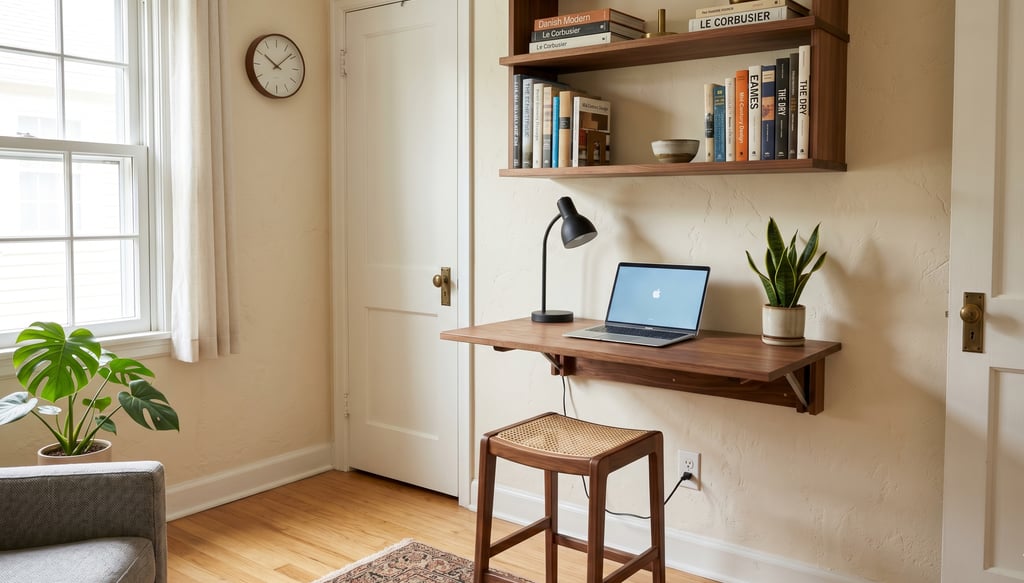
5. The Murphy Bed–Desk Combo: A Practical Guide to Making It Actually Work
A Murphy bed with an integrated desk sounds like the perfect dual-purpose solution — and it genuinely can be — but it comes with real trade-offs worth knowing before you buy. The most important thing to understand upfront: in most Murphy bed–desk units, you cannot leave items on the desk surface when you fold the bed down. Anything on the desk has to be cleared first. For occasional guests that’s totally manageable, but if you’re folding and unfolding daily, it adds friction that some people underestimate. Factor that into your decision before committing to a $1,500+ unit.
That said, for a room that hosts guests only a handful of times a year, this setup is genuinely hard to beat. A wall-mounted fold-down desk — even without the Murphy bed attached — is a lower-commitment starting point that delivers the same disappearing-act benefit for just the workspace. Mounted at the right height, it folds flat against the wall and takes up zero floor space when closed. Pair it with a counter-height stool that slides under a nearby shelf when not in use, and the whole work setup vanishes in under 60 seconds. This is the more renter-accessible version, usually running $150 to $400 versus the full Murphy system, and it requires only two wall studs and a drill.
If you do go the full Murphy bed route, look for units where the desk surface is on the exterior of the cabinet — meaning it stays accessible and usable even when the bed is down. Some manufacturers build this in; others don’t. Read the product specs carefully. Integrated shelving on either side of the unit is worth prioritizing over a lower price tag, because flanking shelves do double duty as both storage and visual anchors that make the wall feel intentional rather than like a piece of furniture dropped in front of drywall. Keep the styling simple and functional: a small task lamp, a compact cable management strip, and a single plant on the shelf are all you need to make the space feel lived-in without cluttering a surface you’ll need to clear regularly.
Affiliate picks:
Wall-Mounted Fold-Down Desk— The practical starting point; folds flat, installs in an afternoon.
Compact Cable Management Power Strip with USB Ports — Keeps the fold-down desk surface clean and charge-ready.
Counter-Height Backless Stool, swivel — Slides under a shelf when not in use; space-efficient seating for fold-down desks.
Follow Us
Contact
© 2025. All rights reserved.
2 Fat Cats Home Decor brings stylish, cozy inspiration from living rooms to bedrooms and beyond — helping you create a warm, inviting home you'll never want to leave.